


Welcome to The Vermont Early Ed Bulletin, your source for current data and resources related to Act 76 and early childhood education policy. The regular bulletin will be back with more information from BBF and our partners this fall. This month, we are dedicating the bulletin to our newly released analysis showing how policy change and investment have dramatically lowered child care costs for Vermont families.
If you have questions, ideas, or resources you’d like us to include in future editions, we’d love to hear from you: [email protected]
We aren’t talking enough about how much families in Vermont are saving on child care.
Today we are sharing the most robust picture we’ve been able to paint of how policy change and investment have increased child care affordability for families.
We have known that Vermont’s child care policy changes and investments are making a difference for families, but until now we could not show the dollar impact year by year. By cross-referencing 24 data sources, we measured how those changes have affected what families pay, both in dollars and as a share of income, every year from 2018 to 2026. Even with our ongoing monitoring of Vermont’s child care landscape, we were surprised by the extent of the financial impact.

In 2021, a low-income family earning less than $40,000 per year spent more than a third of their income (about $14,000 a year) on child care for an infant and preschooler. Today, a family in that same situation, enrolled in the Child Care Financial Assistance Program (CCFAP), pays nothing. A middle-income family at 450% of poverty saw their child care bill peak at almost $37,000; today, that same family pays $15,600. For families enrolled in CCFAP with incomes all the way up to 575% of the federal poverty level, we have seen radical drops in the cost of child care, measured both as a share of household income and in dollars. This is not only a story about the lowest-income families. It is also about middle-income Vermont families finally getting relief—the ones who, before 2024, earned too much to qualify for help and too little to absorb the cost.
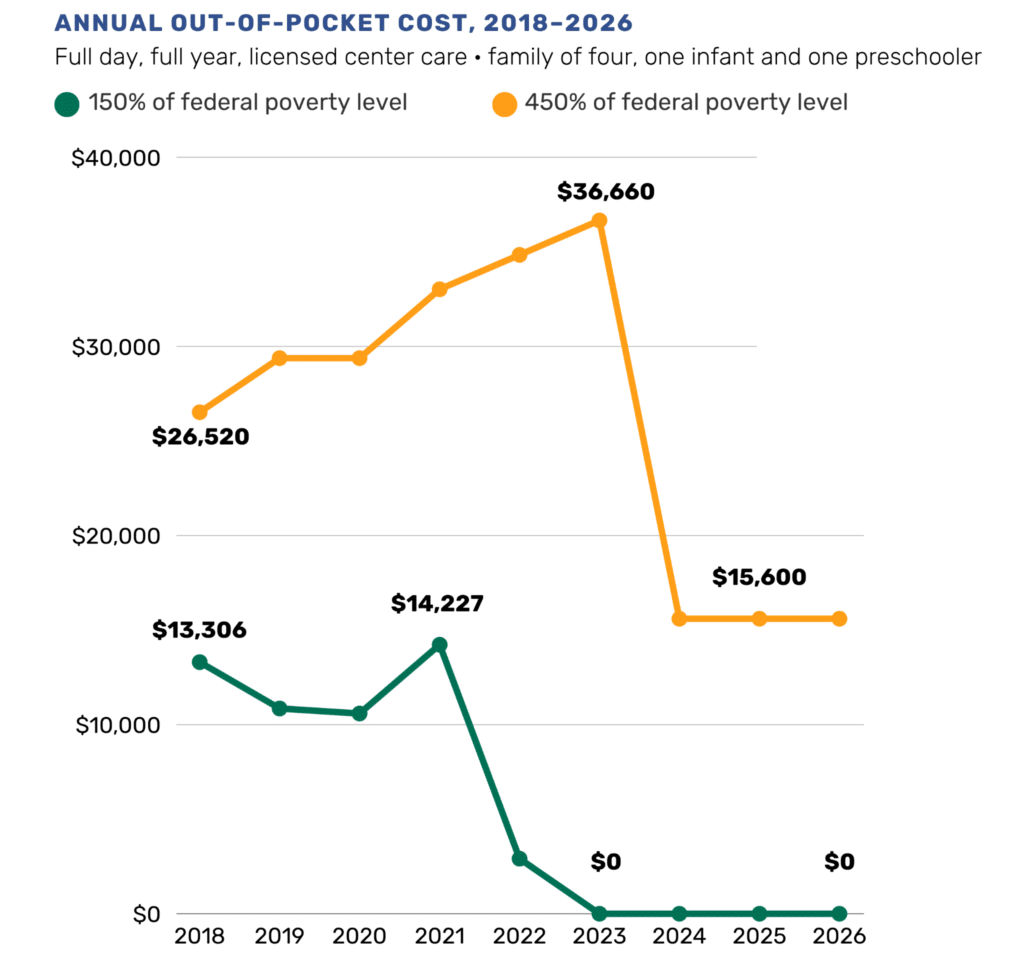
This matters most when you consider what we already know about how families are doing. Earlier this year, with the RAPID Survey Project and Stanford University, we heard that across every income level and background, Vermont families are struggling to afford the basics: food, housing, utilities, and health care. In Vermont, child care is the rare essential that has moved the other way. For a family already stretched thin across all of those other costs, a child care bill falling from $14,000 to $0, or from $37,000 to $16,000, is not a line item in the state budget. It is a game-changing budget shift and policy change that very likely means low- and middle-income families are less likely to be choosing between necessities like heat, food, and the ability to afford child care.
View the interactive visualization and find out more about the methodology at Vermont’s Early Childhood Data & Policy Center, which includes additional data for different family constellations and levels of income as well as registered family child care home costs.
Find out more about the child care affordability analysisVermont has made historic policy decisions and investments in child care. This analysis allows us to more fully understand the transformative impact of what this has meant for families in Vermont.