
Last month, we wrote about Goal 2 of Vermont’s Early Childhood Strategic Plan 2030, All Children Are Raised in Safe, Healthy, and Healing Environments. Today, we’re turning to Goal 3: All Children and Families Have Access to High-Quality Opportunities That Promote Child Development and Well-Being.

Where this work started for me
Some of my earliest memories are from Saxon Hill School, a Reggio Emilia–inspired parent cooperative preschool in Jericho, Vermont. I remember the sledding hill out back. The woodworking table, where we learned how to use a real hammer. My parents coming in for snack time and getting to know my classmates alongside me. I remember making friends, trying new things, and being challenged in ways that felt big at the time and turned out to be foundational.
I was lucky to have early educators like Michelle Campbell, whose care and expertise are a big part of why those years stayed with me. That kind of environment, with that kind of educator, shouldn’t be a privilege—it’s what every child deserves.
I think about that often in this work—the privilege of having had access to that kind of experience when I did, and what it means to want every Vermont child to have something like it, or even more.
Why is Goal 3 important?
Our vision is that every child in Vermont will have access to opportunities that nurture their social, physical, and intellectual growth and support their well-being.
Early experiences and relationships are the foundation of healthy development. In order for children to thrive in school and life, they need positive experiences with trusted caregivers and individualized developmental support.
Moving from vision (or plan) to action
To advance Goal 3, Vermont must increase equitable access to early childhood education, timely screening and evaluation, and early intervention services. This includes supporting children with disabilities and developmental delays in early childhood education programs, schools, and other community spaces.
Goal 3 also aims to reduce or eliminate exclusionary discipline (suspensions and expulsions) in early childhood settings.
We need to keep children at the center of Vermont’s prekindergarten–Grade 3 (PK–3) education transformation. Vermont’s PK–3 education system is undergoing major transformation as part of Act 73, the state’s redesign of public education. While the long-term vision for early learning is still being developed, this is a key moment to rethink how Vermont supports its youngest learners.
In addition, we need to better support early childhood education programs so they can ensure high-quality early childhood education environments with well-prepared educators. This includes equipping programs to invest in mental health supports, respond to trauma, and provide resources to help meet basic needs of students and staff.
There are many more examples of actions to work toward Goal 3 in the full Strategic Plan.
How can you get involved?
Please join us on May 18 in Waterbury for the Strategic Plan Summit, or join a virtual meeting in May.
The success of this Plan depends on each of us being a champion to make change. Are you a champion for students with disabilities or developmental delays; making access to early childhood education, programs, and services more equitable; or increasing supports for early childhood programs and educators? Champions can be organization leaders or community advocates. Tell us where you are already working to make change by signing on to the Plan.
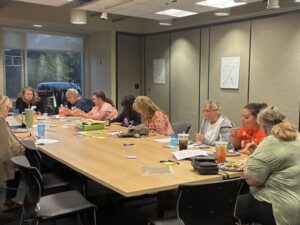
Sign On to the PlanYou can also get involved with an Early Childhood Regional Council or a state-level Strategic Plan Committee to help BBF track progress and identify challenges that can inform changes to policies and programs. These groups gather virtually 4–8 times a year and are open to the public. Reach out if you are curious to learn more.
Join a Regional Council Meeting Join a Strategic Plan Committee Meeting